Alluvi Retatrutide 20 mg: Detailed Explanation, Peptide Structure, and Terminology Guide
What Is Retatrutide?
Alluvi Retatrutide 20 mg is a synthetic investigational peptide studied in metabolic and endocrine research. It belongs to a category of laboratory-engineered peptides designed to interact with multiple hormone receptors involved in physiological regulation.
From a scientific classification perspective, retatrutide is described as a multi-receptor agonist peptide. This means its molecular design enables it to bind to more than one receptor type, allowing researchers to study combined signalling pathways under controlled conditions.
Retatrutide is not a dietary supplement, cosmetic ingredient, or licensed pharmaceutical product. It remains a research-stage compound, restricted to scientific and investigational settings.
Understanding the Name “Alluvi Retatrutide”
Alluvi Retatrutide is not an internationally recognised non-proprietary name (INN) or an approved pharmaceutical brand. Instead, it follows a compound-plus-identifier naming convention commonly used in peptide research and catalogue references.
In research and laboratory contexts, peptide names are often paired with:
-
A supplier or laboratory identifier
-
A catalogue reference
-
An internal product-line name
Over time, these combinations become searchable terms, even though they do not represent a distinct chemical entity. In this case, Alluvi Retatrutide refers to retatrutide identified under a specific naming convention, not a different compound.
What Does “Alluvi Retatrutide 20 mg” Mean?
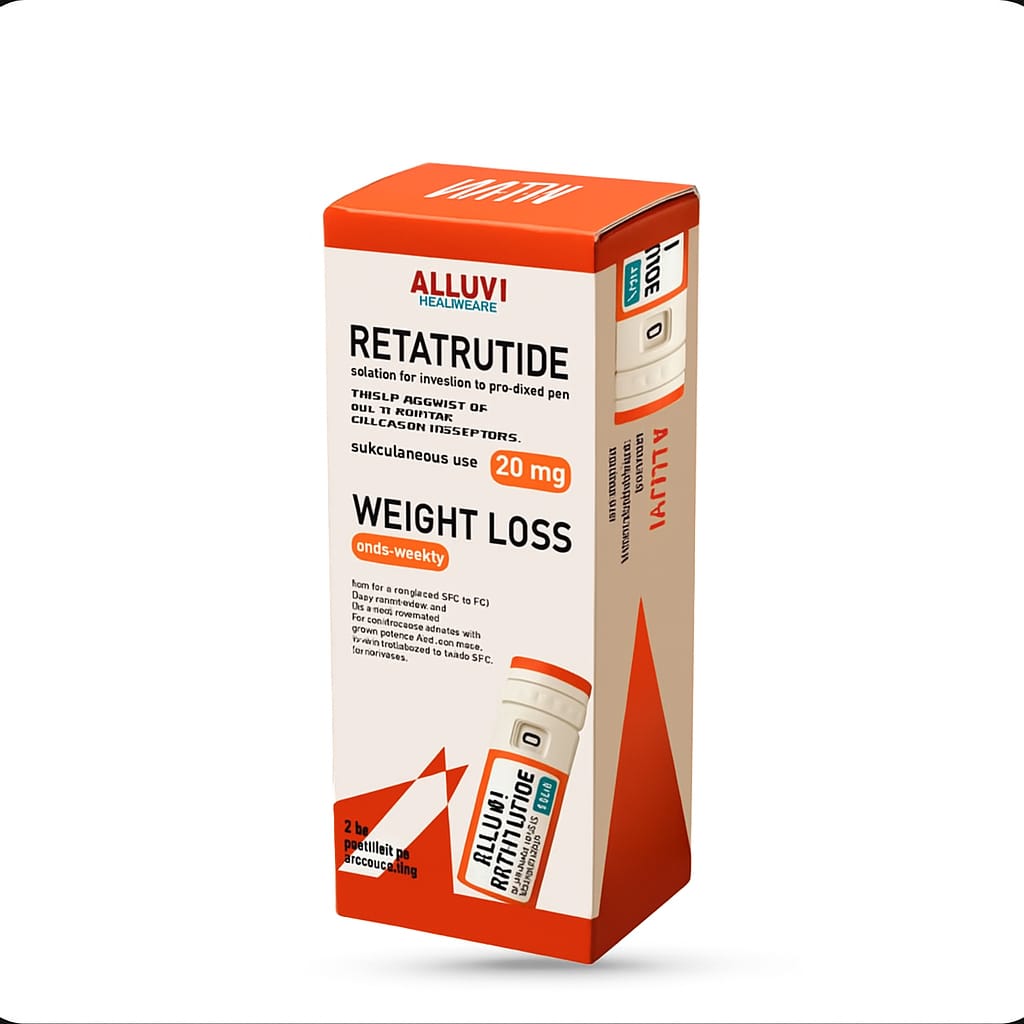
The phrase Alluvi Retatrutide 20 mg refers to a quantitative mass label, not a dosage or usage instruction.
Key clarification:
“20 mg” describes total peptide mass, not administration guidance.
In peptide research terminology, “20 mg” typically indicates:
-
The total amount of retatrutide peptide contained within a vial, cartridge, or pen
-
A packaging or inventory specification
-
A documentation value used for handling and record-keeping
It does not define:
-
A single dose
-
A daily or weekly amount
-
Any approved or recommended use
Understanding this distinction is essential for correct interpretation.
Milligram Labelling in Peptide Research
Milligram (mg) labelling in peptide research differs significantly from labelling used for approved medicines.
In research contexts:
-
Milligrams indicate mass only
-
Concentration depends on dilution and preparation
-
The same mass can yield different concentrations depending on volume
Therefore, Alluvi Retatrutide 20 mg should always be interpreted as a mass-based identifier, not a standardised or approved dose.
Peptide Structure and Composition of Retatrutide
Retatrutide consists of a precisely defined amino acid sequence synthesised using controlled peptide production techniques. Like other synthetic peptides, it is manufactured to strict specifications to ensure sequence accuracy and consistency.
Structural characteristics include:
-
A specific amino acid chain length
-
Molecular modifications designed to improve stability
-
Structural features intended for receptor interaction
These properties are critical for laboratory analysis, reproducibility, and scientific evaluation.
Classification of Alluvi Retatrutide 20 mg as a Research Peptide
Alluvi Retatrutide 20 mg falls under the classification of a research peptide. This classification carries important implications:
-
It is studied in scientific or investigational environments
-
It is not authorised for general therapeutic or consumer use
-
It is governed by research protocols rather than pharmaceutical distribution regulations
Any reference to Alluvi Retatrutide 20 mg should therefore be interpreted strictly within a research and informational framework.
Terminology Commonly Associated With Alluvi Retatrutide 20 mg
Readers researching Alluvi 20 mg often encounter related terms, including:
-
Retatrutide peptide
-
Retatrutide compound
-
Retatrutide 20 mg vial
-
Retatrutide research material
These terms generally refer to the same underlying peptide, with differences arising from naming conventions rather than chemical composition.
Clarifying Common Misunderstandings
Misunderstanding 1: “20 mg” means a recommended dose
This is incorrect. It represents total peptide mass only.
Misunderstanding 2: Alluvi Retatrutide is a separate drug
It is not. “Alluvi” functions as an identifier, not a distinct compound.
Misunderstanding 3: Different milligram labels indicate different formulations
In most cases, milligram labels reflect total mass, not chemical differences.
Frequently Asked Questions
What is Alluvi Retatrutide 20 mg?
Alluvi Retatrutide 20 mg refers to retatrutide peptide identified under the “Alluvi” naming convention, with “20 mg” indicating total peptide mass.
Is Alluvi Retatrutide different from retatrutide?
No. The underlying compound is retatrutide; “Alluvi” is an identifier.
Does “20 mg” represent a dosage?
No. It represents mass, not an approved or recommended dose.
Is retatrutide an approved medicine?
Retatrutide is investigational and limited to research contexts.